
Wealth inequality has been increasing for over 50 years, but post covid acceleration due to inflationary pressures, technological changes like AI and rent-extraction by platforms, as well as the geo-political movements towards right wing nationalism have brought Gen X & Millennials especially to the tipping point. If we were to take a cue from the historical precedence - we are looking at 3 dominant outcomes in a prolonged period of reduced consumption, social unrest and distrust, further flow of capital into real world assets.
How We Got Here
Current situation can be traced back to three major forces that gained momentum post 1970s:
Globalization and Marketplace Monopolization One primary driver has been globalization and emergence of online marketplaces as the settlers of demand-supply relationships. While these forces have spurred economic growth, they have also created a winner-take-all economy where platform and capital owners in globalized industries disproportionately benefit. The incentive in a winner-take-all economy is to monopolize and the method utilized in most business models has been that of discounting and killing competition.
The decline of manufacturing jobs, coupled with the rise of platforms and marketplaces has pushed a large chunk of the population, especially in emerging economies, into the gig economy. Automation has further exacerbated the economic insecurity of large segments of the population.
Loose Monetary and Tax Policies
Loose monetary policies especially after 1985, characterized by low interest rates and quantitative easing, have allowed existing capital or asset owners (financial, tech, real estate) to disproportionately benefit and inflate asset prices, while wage earners and those with no existing assets have seen their purchasing power diminish.
Tax policies have also played a significant role. Across many developed nations, there has been a trend towards lower marginal tax rates on high incomes and capital gains. These policies, often justified by arguments for stimulating investment and economic growth, have inadvertently allowed wealth to accumulate at the top without sufficient redistribution mechanisms.
Finnicization of Life’s Basics There were no student loans until the 1960s. Until 1970, there was no concept of a house mortgage. Until as recently as 2020 - there was no concept of buy now pay later for every single purchase you make from any ecommerce site.
The financialization of life’s basic necessities in education, health and shelter has impacted the Gen X and Millennials. Financialization of day-to-day products will hit the millennials the hardest.
Erosion of Collective Bargaining Lastly, the erosion of labor union power and stagnant minimum wages have limited the ability of the working class to capture a larger share of economic gains, leading to a widening wealth gap and lower productivity.
How Bad Do The Millennials Have It
Heavily Indebted Early In Life: Imagine a mid generation millennial who is 40 years old today with a master’s degree, a family of 2 kids, and a house. At this age, they probably have or have paid off a portion of the following debt:
Undergraduate Degree: $29,000
Master’s Degree: $150,000
Starter House: $500K+
This is in stark contrast to previous generations who had greater access to debt-free education and lower debt to get to home-ownership. Millenials also face a more competitive job market, with unemployment rates reaching 10% during the Great Recession, and currently hovering at around 14% in 2025.
Less Wage Growth And Share of Capital Gains Millennials have also seen less wage growth in their prime years, driven primarily by economic downturns, and corporate profit hoarding. Below is a comparison of average real wage growth amongst boomers and millennials.
Boomers’ Prime Work Years (1970s-1990s): Experienced average real wage growth of 2.1% annually.
Millennials’ Prime Work Years (2000s-2020s): Have seen average real wage growth of 0.3% annually, significantly hampered by the Great Recession and stagnant wage policies.
Studies and observations indicate that roughly 35-40% of millennials participate in the gig economy in a full time or supplemental way. These jobs often also lack benefits that come with full time employment.
Less Wealth Accumulation
This higher cost of becoming an employable, family person with a stable job and house coupled with lower returns on that investment is impacting the wealth that Millennials have, and in turn how safe and motivated they feel about their future
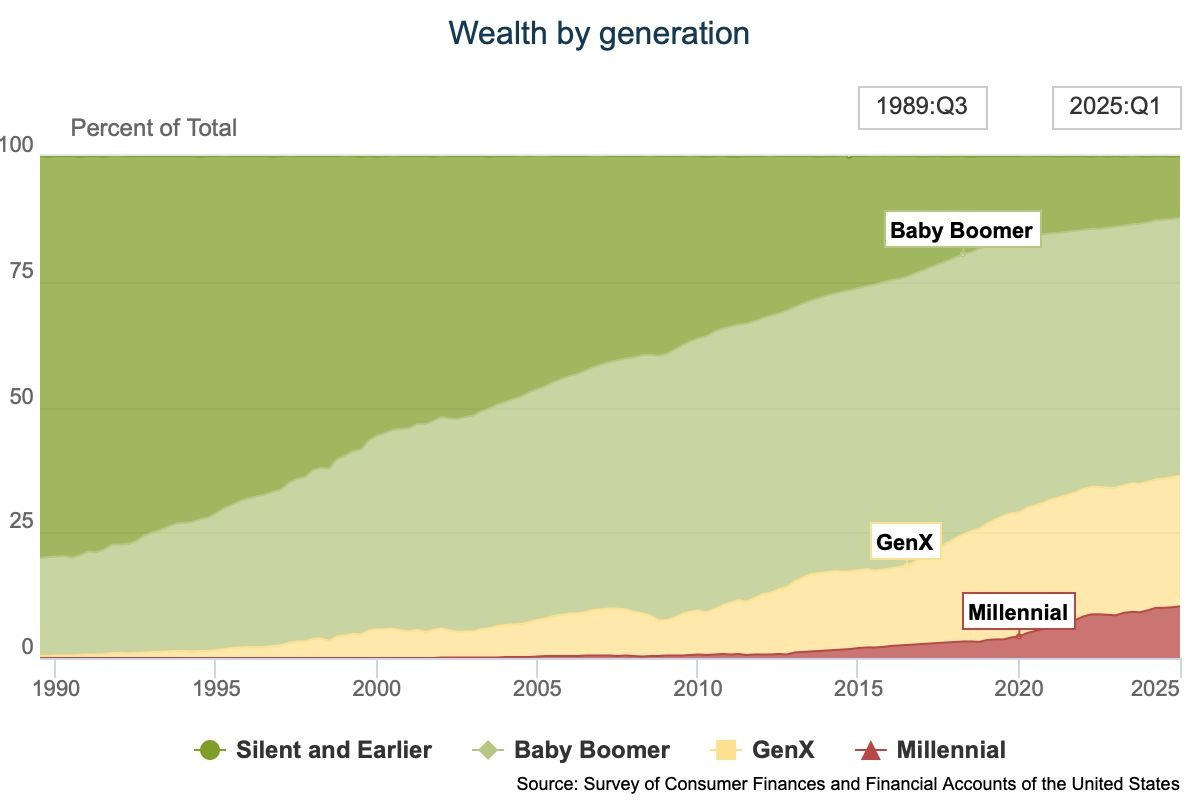
To put this in perspective, if you compare the access to wealth at the same age range of 45-60 across generations.
Boomers had 50% of the wealth share
Gen X has 25% of the wealth share
Millennials will have less than 20% of share
What Will It Impact
Consumption Drag The economic consequences of extreme wealth inequality are far-reaching. A highly unequal distribution of wealth can lead to reduced aggregate demand, as a smaller portion of the population controls a disproportionate share of purchasing power. This can stifle economic growth and make economies more susceptible to financial crises.
Consumer Choice & Competition Elimination Furthermore, wealth concentration can lead to the formation of monopolies and oligopolies, where a few dominant firms stifle competition and innovation, ultimately harming consumers and smaller businesses. Investment patterns can also be skewed, with capital flowing into speculative ventures or luxury goods rather than productive investments that benefit the broader economy.
Social Distrust Beyond economic effects, wealth inequality has profound social consequences. It can erode social cohesion and trust, fostering resentment and division between different segments of society.
Mass Social Gentrification Access to essential services such as education, healthcare, and housing often becomes stratified, with the wealthy enjoying superior opportunities and outcomes. This creates a cycle of disadvantage, where those born into less privileged circumstances face significant barriers to upward mobility, perpetuating inequality across generations. Moreover, high levels of inequality are often correlated with increased crime rates, poorer public health outcomes, and diminished overall societal well-being.
Reduced Democratic Participation Perhaps the most insidious aspect of extreme wealth inequality is its impact on democratic governance. The concentration of economic power often translates into concentrated political influence. Wealthy individuals and corporations can leverage their financial resources to influence elections, lobbying efforts, and policy-making processes, ensuring that policies favor their interests rather than the broader public good. This can lead to a phenomenon where the political system becomes unresponsive to the needs of the majority, undermining the principles of representative democracy.
This disproportionate influence can manifest in various ways: funding political campaigns, supporting think tanks that promote specific economic ideologies, and establishing powerful lobbying groups that advocate for policies beneficial to the wealthy. When the concerns of the elite consistently outweigh those of the common citizen, public trust in institutions erodes, paving the way for political apathy, cynicism, or even extremist movements that promise radical solutions. The tipping point in this regard is reached when the democratic process becomes so thoroughly compromised that it can no longer effectively address the underlying economic disparities, leading to a crisis of legitimacy.
What Will They Do & Potential Scenarios
Defining the precise moment of a “tipping point” for wealth inequality is challenging, as it is not a sudden event but rather a cumulative process. However, various indicators suggest that many societies are approaching or have already surpassed critical thresholds. These indicators include:
Stagnant real wages for the majority coupled with soaring executive compensation and capital gains.
Increasing social unrest and protests fueled by economic grievances.
A widening gap in life expectancy and educational attainment based on socioeconomic status.
Perceived corruption and a sense that the political system is rigged in favor of the wealthy.
The rise of populist movements on both the left and right, often exploiting public anger over economic disparities.
If the tipping point is indeed reached and passed without effective intervention, several scenarios could unfold. One possibility is a gradual but significant decline in living standards for the majority, leading to widespread social stratification and a permanent underclass. This could result in a society where social mobility is severely limited, and opportunities are primarily determined by birthright rather than merit.
Another potential outcome is increased political instability and social unrest. As frustrations mount and avenues for democratic change appear blocked, there could be a rise in protests, strikes, and potentially even violent confrontations. Historically, extreme wealth disparities have often been precursors to revolutions or significant social upheavals.
A third, more dystopian scenario involves the establishment of an oligarchy or plutocracy, where a small elite effectively controls both economic and political power, further entrenching their position and making fundamental change extremely difficult to achieve through conventional means. This would represent a profound erosion of democratic values and principles.
Pathways to Addressing Wealth Inequality
While the challenges are significant, there are various policy interventions and societal shifts that could help mitigate wealth inequality and potentially avert or reverse the negative consequences of reaching a tipping point. These include:
Progressive Taxation: Implementing more progressive income tax rates, increasing taxes on capital gains and inherited wealth, and closing tax loopholes that benefit the wealthy can help redistribute wealth and fund public services.
Strengthening Labor Rights: Empowering labor unions, increasing minimum wages to a living wage, and ensuring fair labor practices can help workers secure a larger share of economic productivity.
Investing in Public Goods: Increased investment in quality public education, affordable healthcare, and accessible housing can create greater equality of opportunity and reduce the burden on lower-income households.
Antitrust Enforcement: Robust antitrust laws and enforcement can prevent the formation of monopolies and promote competition, ensuring a more equitable distribution of economic benefits.
Financial Regulation: Implementing stricter regulations on the financial sector can curb speculative excesses and reduce the risk of financial crises that disproportionately harm the less wealthy.
Addressing Global Tax Evasion: International cooperation to combat tax evasion and avoidance by corporations and wealthy individuals can help ensure that wealth is taxed fairly across borders.
Beyond policy, a cultural shift towards valuing collective well-being over excessive individual accumulation, promoting corporate social responsibility, and fostering a greater sense of shared prosperity are also essential. Education and public awareness about the causes and consequences of wealth inequality are crucial for building the political will necessary for meaningful change.
Conclusion
The growing concentration of wealth in the hands of a few presents a profound challenge to modern societies. While wealth inequality has always existed, its current trajectory suggests that many nations are nearing or have already crossed a critical tipping point, with potentially dire consequences for economic stability, social cohesion, and democratic governance. The historical record demonstrates that unchecked inequality can lead to social unrest and systemic breakdown. However, by understanding the multifaceted causes and consequences of this disparity, and by implementing a comprehensive set of policy interventions and fostering a more equitable societal ethos, it is possible to mitigate the risks and work towards a more just and sustainable future. The choices made today regarding wealth distribution will determine whether societies descend further into entrenched inequality or move towards a more inclusive and prosperous future for all.
Historically, periods of significant wealth inequality have led to major social and economic upheavals. From the Gilded Age in the United States to the late Roman Empire, excessive concentration of wealth has been linked to political instability, populist movements, and ultimately, a decline in societal well-being.